Rapid Response
Urgent faults and service recovery, routed to the Response Desk with a quality record required before closure.
Business design & engineering
Define the offer. Connect the work. Build the rules that hold it together.
An original portfolio demonstration: a fictional property-services business, with a business blueprint and a tested Python rules prototype.
The challenge
The starting point was a service-business concept without defined packages, connected intake, clear approvals, or proof required before closing work. The task was to design how the business would operate, then implement a focused part of that design.
Create
The blueprint defines three service offers, who owns each one, the information needed to begin, and how completed work should be reviewed.
Urgent faults and service recovery, routed to the Response Desk with a quality record required before closure.
Recurring maintenance needs, owned by Service Planning with documented work review.
Scoped improvement projects, owned by the Projects Team with scope approval and quality checks.
These are the demonstration business's service categories, not service promises or response-time commitments from Dingir Prime Labs.
Organize
Intake and triage lead to scoping, management approval, execution, quality review, and closeout. Each handoff identifies who acts next and what must be in place.
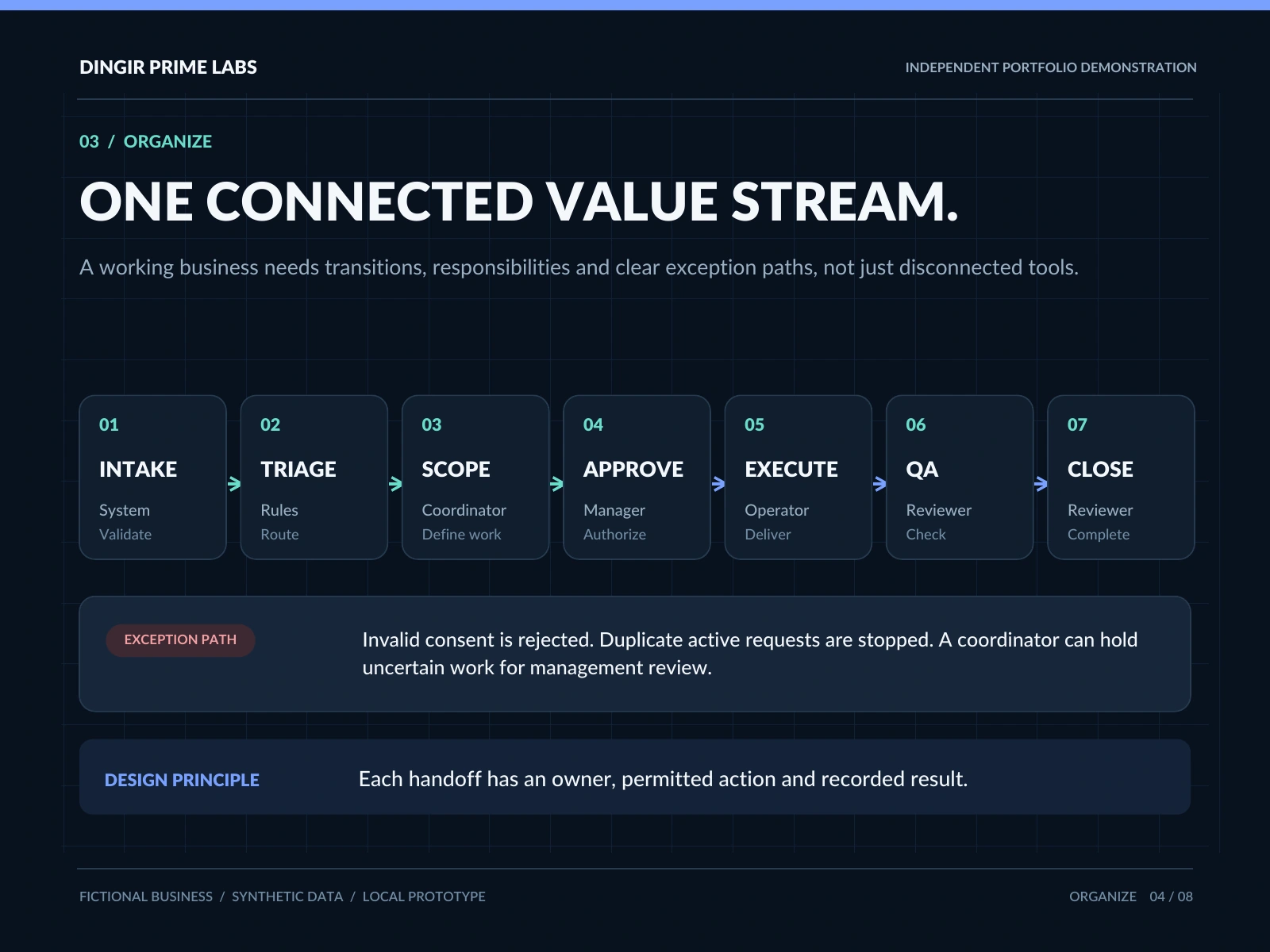
Missing consent and active duplicate requests are rejected. Uncertain work can be placed on hold for a manager to resolve, rather than silently continuing.
Build
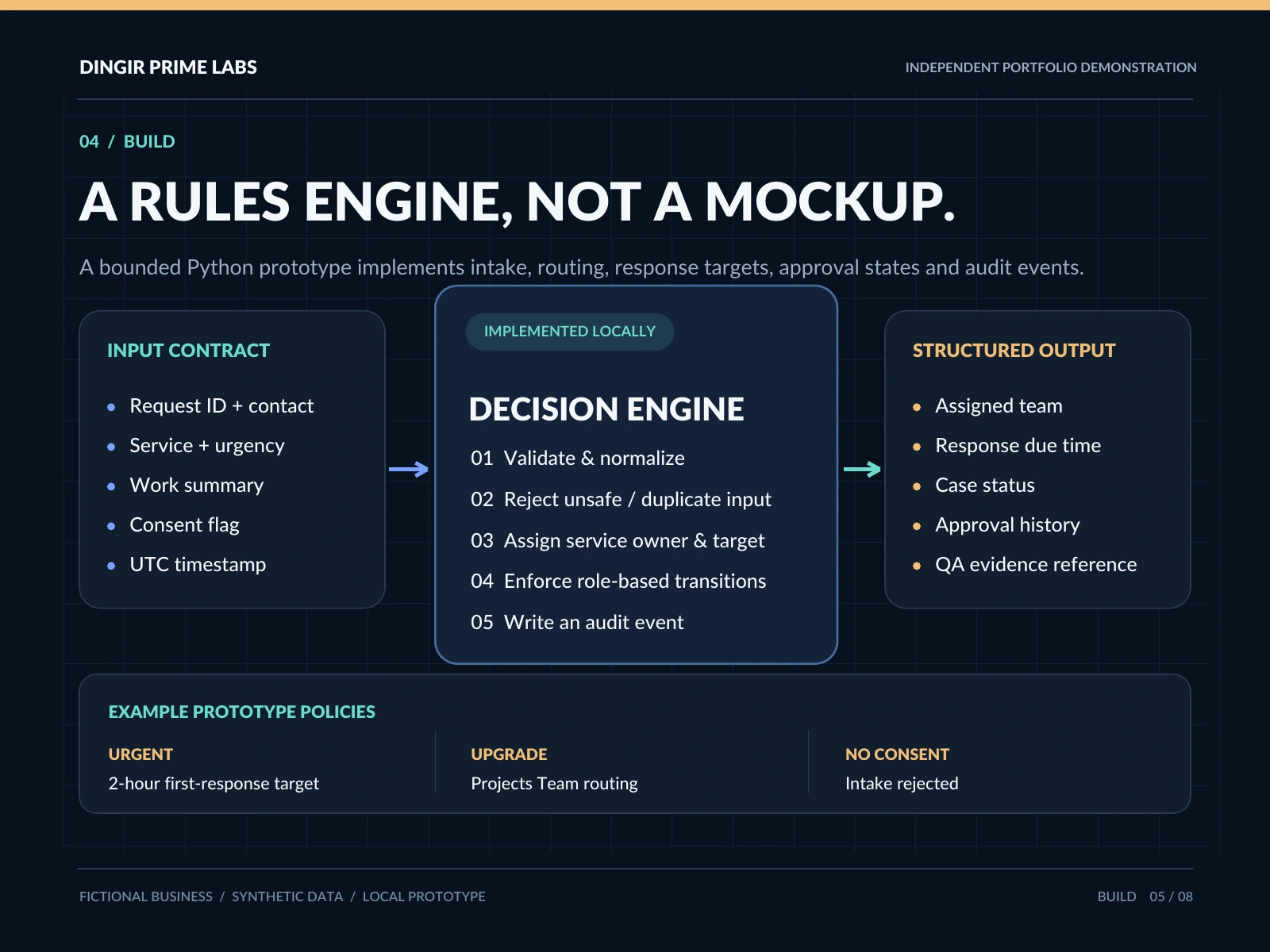
The Python engine accepts structured inquiries, assigns the service team and response target, manages case states, and records each accepted transition.
Control
A coordinator defines the scope. A manager approves it before work can start. The assigned operator supplies a quality-evidence reference, and a different reviewer must close the case.
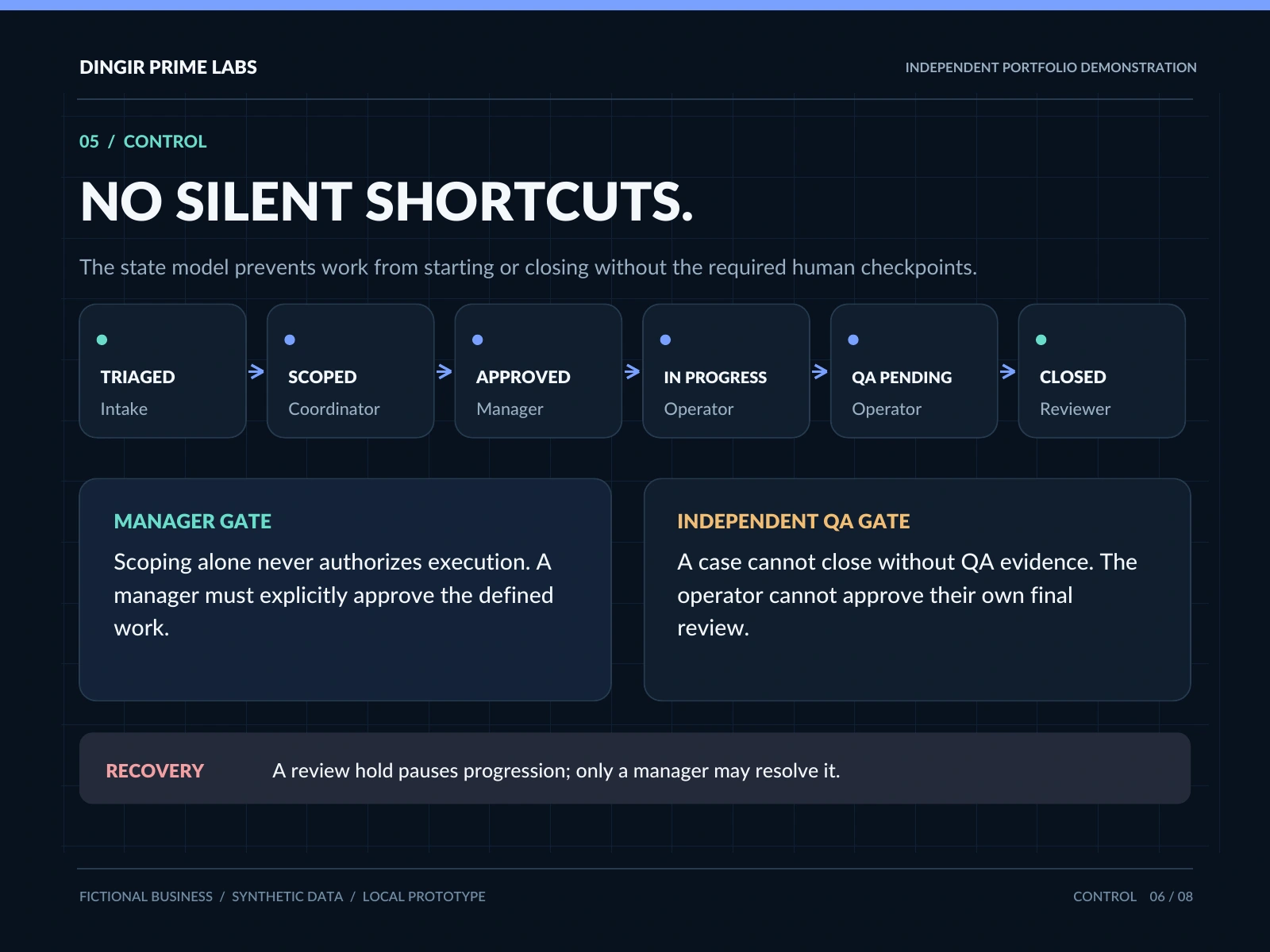
These are application rules demonstrated through supplied role and actor values. A production system would also need authenticated identities, protected storage, and integration-specific controls.
Evidence
All 25 supplied automated tests passed again during this case-study review on October 13, 2026, using Python 3.14.7 on Windows, with no failures, errors, or skipped tests.
Checks cover service owners, urgency targets, missing consent, invalid input, repeated request IDs, and active duplicates.
Checks cover approval before work, evidence before closure, blocking operator self-review, and manager resolution of holds.
The synthetic example progresses through submission, scope, approval, work, quality submission, and closure, with a separate reviewer recorded.
A business design connected to working, tested workflow logic. The eight-page case study, source review, test suite, and repeatable walkthrough support that scope.
The scenario and data are fictional. The prototype is an in-memory rules engine, not a live multiuser service. CRM, scheduling, payments, external messages, durable storage, and production security are outside this implementation. No client sale, business results, or production deployment is claimed.
For your project
The same kind of work can start with your business idea, an unclear process, or a system that needs better rules. Together, we can define the blueprint, the build, or both around your goals.
Discuss a similar project